
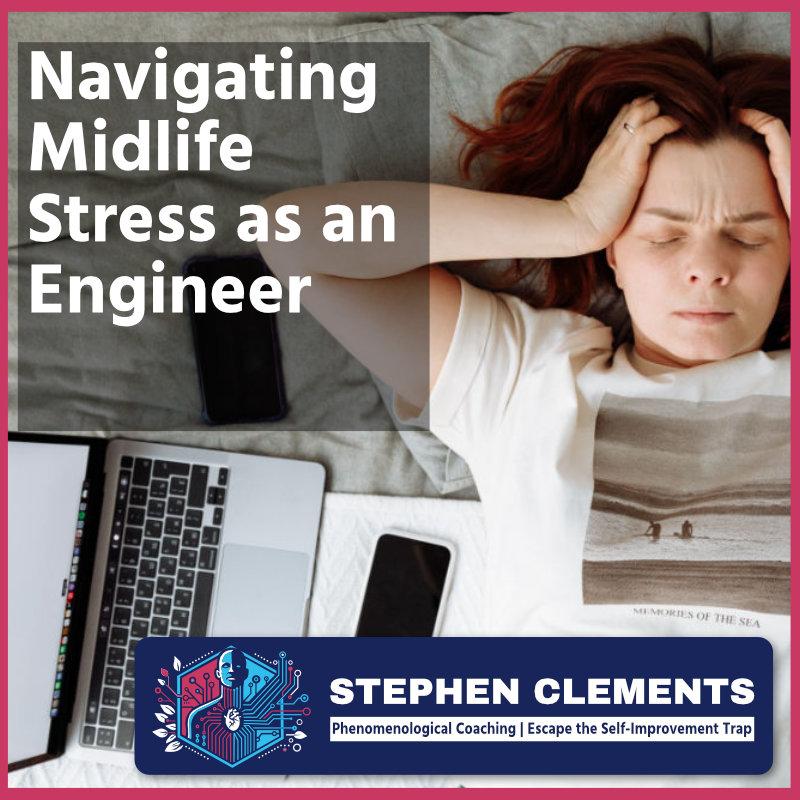
Navigating Midlife Stress as an Engineer
13 March 2026
What if the problem isn't the problem?
There's a particular kind of exhaustion that visits engineers in midlife. It doesn't announce itself loudly. It arrives quietly – in the Sunday evening dread before Monday, or in realising that the work that once engaged you now just… fills time. You start to feel a restless certainty that something needs to change, even when you can't name what.
If this sounds familiar, you're not unusual. And you're not broken. And you’re not alone.
But the way most people respond to these experiences, with an instinct to fix it, may be making things worse.
The fix-it trap
Engineers are, by training and temperament, problem-solvers. You're comfortable with complexity, skilled at diagnosis, and accustomed to there being a solution if you can just identify the right variable.
So when midlife stress arrives, it's natural to apply the same logic. You asked yourself, *”What needs to change?” *Dust off the CV. Research a different company. Maybe a new role, a new team, a new industry. The problem is identified (this situation) and the solution is obvious (a different situation).
This approach treats you as a system with a fault to be found and corrected.
The trouble is: it rarely works. You can change the company and take the disquiet with you. You can accept the new role and find yourself, six months later, sitting with the same unnamed weight. Short-term relief, yes. Sustained change? Rarely.
And there's something else. The frantic search for an exit creates its own stress: the pressure of needing to find the right answer, the anxiety of not having found it yet, the subtle shame of feeling stuck when you're supposed to be good at solving things.
What's actually happening
Here's a different way to think about it.
Most of the stress you're carrying isn't about the situation you're in. It's arising from your relationship to it – the meaning you're making of it, the stories you're telling yourself about what it says about you, what you've missed, what's no longer possible.
That's not a criticism. It's phenomenology – the study of lived experience. The world you're inhabiting isn't just a set of objective facts. It's a world as you're experiencing it, shaped by your history, your values, the things you care about most deeply.
When engineers hit midlife, what often surfaces isn't a flaw in the external situation. It's an encounter with questions that were always there, waiting for a quieter moment:
What actually matters to me? What kind of life am I building? Am I the person I wanted to become?
These aren't problems to be solved. They're invitations to be met – requiring you to slow down, pause, and dwell with the questions rather than rushing direct to change through action.
Midlife as a threshold, not a crisis
The word "crisis" frames midlife as something going wrong. But many philosophical and psychological traditions understand it differently – as a threshold moment, a liminal space where the assumptions and identities that carried you through early adulthood begin to loosen, creating space for something more authentic to emerge.
This isn't comfortable. But it isn't pathological either.
The engineers I work with who navigate this most meaningfully aren't the ones who find the quickest fix. They're the ones who slow down enough to actually be with what's arising – to get curious about it rather than immediately strategising their way out of it.
That shift — from solving to inquiring — is often where things begin to move.
Some places to begin
If you're sitting with this right now, a few thoughts:
Notice what you're actually feeling, not just thinking. Engineers tend to live a lot in their heads. Midlife stress often shows up in the body first – tension, flatness, a kind of weight. Getting curious about your felt experience, rather than immediately analysing it, can open up entirely different information.
Interrogate the change agenda before acting on it. Before updating the CV, it's worth asking: what am I hoping will be different? And more honestly: is that thing actually determined by where I work, or does it travel with me? Sometimes the answer is genuinely "the situation needs to change." But often, that clarity only comes after you've sat with the question long enough.
Look at what's been quietly set aside. Midlife often involves a reckoning with things that got lost along the way – friendships that thinned out, interests that got deprioritised, parts of yourself that were set aside for the career or the family or the mortgage. These aren't regrets to be carried. They're information about what you're actually hungry for.
Take small, experimental steps. You don't need a grand redesign of your life. Experiments are lower-stakes and more revealing than decisions. What's one thing you could do differently in the next two weeks, just to see how it feels?
Don't do this in isolation. This is important. Engineers in particular tend to treat this as a private problem, something to be worked out alone, in the head, in the evenings. But the questions that midlife surfaces are too significant – and too easily distorted by our own self-protective patterns – to navigate without someone else in the room. A peer who gets it. A community of people in similar territory. Or a coach who can hold the space for something more than problem-solving.
The invitation underneath the stress
I work with engineers and other intellectually-driven professionals not because they need someone to fix them, but because they're often more alive to these questions than they give themselves credit for.
The midlife stress that engineers carry is frequently the signal of a self that hasn't yet been fully inhabited. The disquiet isn't the problem. It's the door.
If you're finding yourself in this territory and want to think about it with someone, I'd be glad to talk.
Stephen Clements works with engineers, leaders, and other thinkers navigating transitions that matter. His approach to coaching is grounded in phenomenological philosophy – the conviction that transformation emerges not from being fixed, but from being more fully met.