
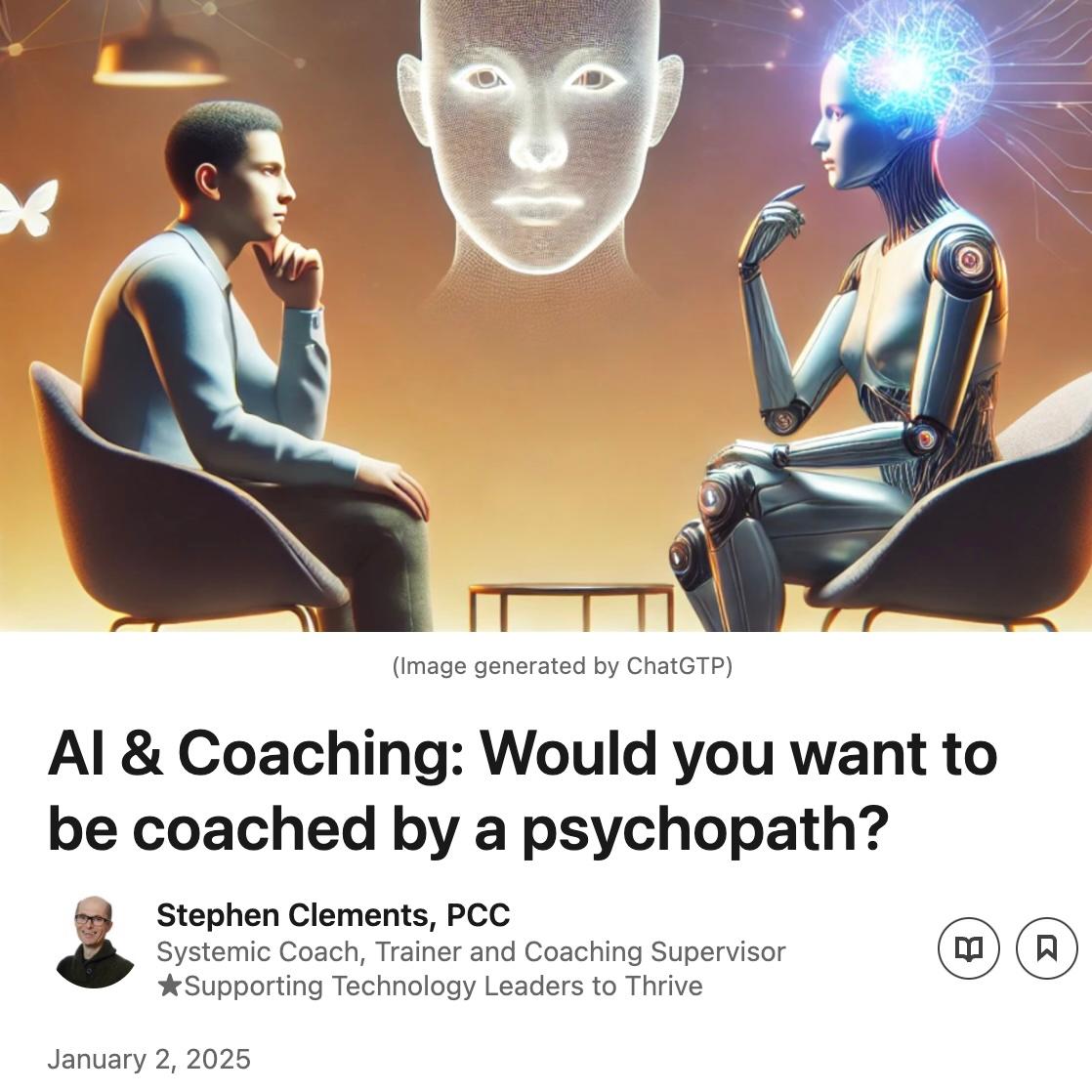
Would you want to be coached by a psychopath?
2 January 2025
Note: The following article was also published on LinkedIn. If you'd like leave a comment, then please head over to LinkedIn here
After recently discussing artificial intelligence (AI) and coaching with some peers, I found myself musing on the difference between a psychopath and an AI coaching system. This led to the question: Would you want to be coached by a psychopath?
Regardless of how we view it, AI increasingly impacts many aspects of our lives. As a coach and technologist, I’m sometimes amused by the views expressed within the coaching industry about AI's impact. These views cover everything from how AI can assist coaches to how AI will replace them.
Professional bodies such as the International Coaching Federation have published AI frameworks and standards for AI-based coaching systems, while regulatory bodies such as the European Union are introducing regulations around training and transparency. Encouragingly, coaches and coaching supervisors are starting to have conversations about the ethics of AI in coaching.
However, given the pace at which technology develops, it’s no surprise that companies are racing to advance this technology and that various versions of AI Coaching bots already exist. They hope to offer organisations the opportunity to scale up while reducing costs in areas such as coaching, training, well-being, and more. What organisation wouldn’t want that?
From a technology and business point of view, this is nothing new. Companies looking for competitive advantage often seek out new markets for technology and hope to capitalise by being the first to launch into these markets. At the same time, the capabilities and benefits are often overhyped. As a result, areas such as security, privacy, unintended consequences, environmental impact and ethical considerations are often only afterthoughts.
However, by focusing on the technology or its benefits to organisations, we’re losing sight of some important questions: Will AI coaching be as impactful as human coaching? Will people want to be coached by an AI coach? What could be the unintended consequences?
These are nontrivial questions to answer. Diving deeper reveals additional complexity and even more challenges. For example, to understand whether AI coaching could be as impactful as human coaching, we must first ask, what is coaching? And when we talk about impact, what do we really mean? And how do we measure impact while controlling for other factors? Given that some of these questions haven’t been fully answered for human-based coaches, how can we expect to answer them for AI-based coaching?
Even if we put these questions aside for now, there are other limitations with an AI coaching system; it only emulates one dimension of the coach-coachee relationship: linguistics. The system listens to the input from the coachee and tries to determine a reasonable response based on its understanding of linguistics layered with coaching competencies. Therefore, it might ask a question or offer a reflection. However, what about the other dimensions human beings use for interpersonal communication?
In the mid-twentieth century, psychologist Carl Rogers developed a non-directive therapeutic approach that focused on the human relationship between client and therapist. His person-centred approach believed that individuals have the innate capacity to reach their full potential under certain necessary and sufficient conditions. Before this approach, traditional therapy relied on the therapist being the expert who directed the patient back to being a functioning individual. Although Carl Rogers' work was in the therapeutic domain, it has profoundly influenced contemporary coaching to be client-centred and non-directive.
As the debate on AI and coaching continues, I often wonder what Carl Rogers would think about having an AI system work with human beings in a coaching or therapeutic way. Consider for a moment his three core conditions for necessary and sufficient change:
- Unconditional Positive Regard – where the coach takes a non-judgemental stance and demonstrates genuine care and acceptance of the individual, believing they are already creative, resourceful and whole.
- Empathic Understanding – where the coach attempts to understand the individual’s experience and feelings accurately and compassionately.
- Congruence – where the coach is being real, genuine and authentic with the individual. They aren’t putting on a mask and pretending to be something they are not.
Carl Rogers’ focus on authentic human connection highlights a critical gap in AI coaching: the inability to genuinely embody empathy or congruency.
Like psychopaths, generative AI systems create the illusion of understanding and empathy by mimicking responses gained through training data and programming. They can't understand or experience the world as we do, yet they are programmed to appear as if they do – you might say that they are wearing a mask of humanity behind their unknowing, uncaring, logic-driven programming. It would not feel or experience any difference if you told it, “I love you” versus “I hate you”. It may recognise that each requires a different response pattern, but this would come from a calculated position rather than any felt sense.
Humans learn by experiencing the world, whereas generative AI systems are trained on large linguistic data sets. Our experiences invoke reactions within our nervous system, triggering the release of various hormones that alter our biochemistry. Our respiratory, cardiovascular and hormonal systems will adjust our breathing, heart rate, circulation and more, depending on the situation. Memories will be formed, and connections will be made as neural pathways form or are altered. These biological responses are impossible to fully synthesise in a binary system of 1’s and 0’s.
Consider the difference between reading a book on driving a car versus learning while experiencing it. A book can provide helpful information such as the rules of the road, introduce the sequences involved, and provide other instructions about moving and controlling a motor vehicle. However, it can’t convey what it will feel like; you can’t feel the ‘bite point’ of the clutch or the rush of adrenaline when someone pulls out in front of you, or you get an angry honk from another driver. AI can read more books than we ever will, but it’s incapable of sharing our experiences and empathic understanding.
Our use of language represents a tiny portion of how we communicate. Although Carl Rogers never explicitly talked about coregulation, I believe this provides a foundation for his core conditions.
What is coregulation? Imagine that something has just happened that has frightened or upset you. Your breathing is shallow and quick, and your heart is racing. As you turn to a trusted friend, you’re talking at a hundred miles an hour as you try to explain what’s happening. This friend breathes slowly and deeply, speaking calmly and offering reassurance and empathy. Even though they may not have said much (if anything), your heart stops racing, your breathing starts to slow and deepen, and your voice and thoughts become less agitated. This is an example of coregulation, where your friend's nervous system supports regulating your nervous system from its sympathetic response.
As biological beings, we transmit and receive information beyond the scope of our linguistics. Consider how a smile or a physical touch can release oxytocin or the emotional information transmitted by the heart, which the Heartmath Institute has extensively researched, or how mirror neurons enable us to understand and share the feelings of others. As digital systems, AI can never replicate these human systems.
This brings me back to the question I posed in the title of this article: Would you want to be coached by a psychopath? Isn’t this what organisations turning to AI coaches are ultimately asking? A coach who pretends to understand, who cannot feel or experience emotions and who can only try to mimic empathy and connection.
Another factor of psychopaths is their manipulation of others. This is also present in AI systems. Consider the organisation's goals in providing the AI coaching system. Suppose the organisation’s business model relies on you continuing to use the AI coaching system for a prolonged time. Imagine the organisation wants to report to shareholders that they’ve increased the number of overall active daily users and the revenue per user. Therefore, will it programmed to manipulate you into becoming dependent upon it so that the organisation can maximise their profits?
Is this that much different from being coached by a psychopath?
It might sound like I’m entirely against AI coaching systems, but that’s not the case – I believe they can play an important role. I am against technologists' oversimplification of the coaching relationship as purely an analytical, left-hemisphere-focused activity and coaching experts who have jumped on the AI bandwagon without fully appreciating the technological limitations whilst forgetting what it means to be a human being. I can also understand why this is happening: it’s simply the continuation of putting our thinking mind on an even bigger pedestal, which Dr Iain McGilchrist has highlighted for quite some time and is increasingly prevalent in our Western society.
Coaches typically start by developing the ability to deepen their listening and questioning skills. They then apply frameworks and structure to their conversations. This is similar to where AI coaching systems are currently, except they’ve access to more tools and frameworks than we ever could. Yet, just like humans, they may hallucinate, get things wrong, and not always understand what has been communicated. That’s not to say student coaches or AI systems can’t be useful to coachees – depending on the situation, this imperfect conversation might be good enough to move the coachee forward.
However, human coaches who undertake formal coach training develop a greater range of competencies and learn to use and embrace their humanness more fully. In doing so, they need fewer tools and frameworks. For some, this becomes a lifelong journey as we strive to better understand ourselves and our human experience. In doing so, we bring our humanity into the coaching relationship.
Given how little we know about ourselves, coupled with the digital limitations of AI systems, I’m reasonably confident that I will not be replaced by an AI Coach anytime soon. While AI may complement our work, it is the coach's messy, irreplaceable humanity that will support true transformation for our coachees.
Stephen Clements works with engineers, leaders, and other thinkers navigating to slow down, press pause and uncover that which wants to emerge - supporting them to be more grounded, confident, and resilient. His approach to coaching is grounded in phenomenological philosophy – the conviction that transformation emerges not from being fixed, but from being more fully met.